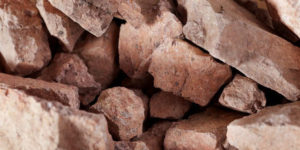
We are on the hills of Maggiora , in the province of Novara, at the foot of Monte Rosa. The red porphyry and rocks of a fossil supervolcano , recognized in 2013 as a Geopark by UNESCO, make up the land on which the vineyards stand which, thanks to the interaction with a favorable microclimate, make this terroir particularly suitable for the cultivation of Nebbiolo (Spanna), Vespolina and other grapes.
In the book "The incredible story of the Sesia Supervulcano" , written by Professor Sinigoi , the extraordinary geological event is well told, which began about 300 MA when there was a huge continent - Pangea - scattered with numerous volcanoes. About 280 MA, after about 10 million years of eruptions, in what will later be the Valsesia, a super eruption occurred which caused the volcanic area to collapse, forming a caldera of at least 15 km in diameter, the supervolcano . In a single blast, more than 500 cubic km of pyroclastic material, burning clouds and ash were thrown into the air, darkening the sky for years, altering the landscape and conditioning the climate. Then everything stopped. About 100 MA, Africa broke away from South America and began its drift, subsequently going to collide with Europe. Because of this push, about 30 MA, the Alpine orogeny began, the birth of our mountains, "making its deepest parts go up, like a curl of butter pushed by a spoon" close to the Insubric Line, and at the time itself showing the entire power system of the supervolcano, now fossil. Thanks to this process, today we can observe on the surface what constituted the earth's crust under the volcano, up to a depth of about 25 km. A unicum in the world.
From a viticultural point of view, this discovery explained and enhanced the diversity and specificity of this area of Upper Piedmont, where the marine sands of the Lessona, the fluvio-glacial soils of the Ghemme, Fara and Sizzano coexist in a small geographical area. and the ferrous and partly volcanic ones of Gattinara, with the volcanic porphyries of Boca and Bramaterra, with a single common denominator: the acidity of the soils.
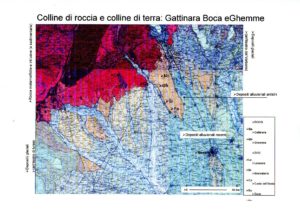
Specifically of the so-called "wines of fire" (Boca, Bramaterra and Gattinara) the soil is made up of porphyry from the ancient caldera dating back 280 MA, much earlier and different from the fluvial and glacial moraines of Alpine origin, although pyroclastic material was also found scattered in neighboring areas that were not specifically volcanic, as an effect of the very powerful explosion. The porphyritic block in which the vineyards that make up the Boca doc are completely inserted, is deep pink, with some quartz inserts